
Why We Use Loxon Primer on Every Brick and Stucco Job in Kansas City
Brick and stucco are alkaline surfaces. Apply regular paint without the right primer and you'll be back in two years wondering why it's peeling. We use Sherwin-Williams Loxon on every masonry job in Prairie Village, Overland Park and Lee's Summit—here's why.
Published October 7, 2026
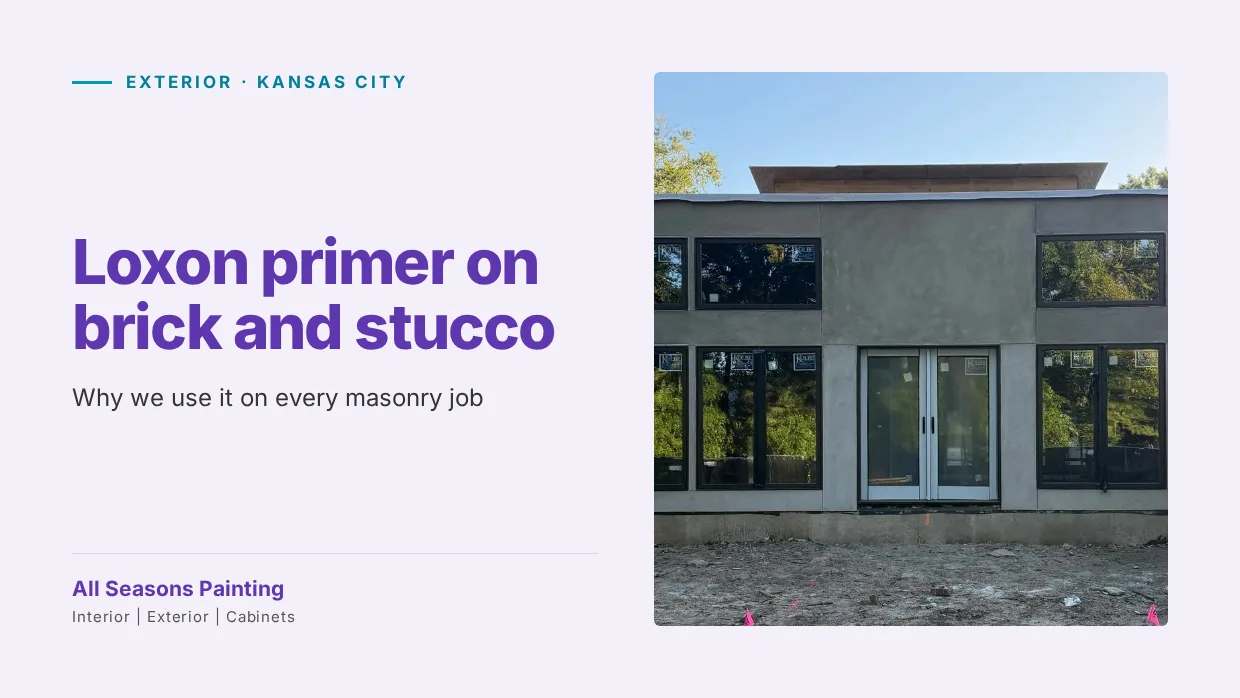
Brick and stucco look solid, but they're some of the trickiest surfaces to paint. They're porous, they're alkaline, and they move with temperature and moisture in ways that stress a paint film from the inside out. Get the prep wrong and you'll be back in two or three years watching the paint bubble and peel away in sheets.
That's why before we apply a single drop of finish paint on any brick or stucco job in Kansas City, we start with Sherwin-Williams Loxon Concrete & Masonry Primer/Sealer. It's not a shortcut step—it's what makes everything on top of it last.
Why Brick and Stucco Are Different
Fresh stucco can have a pH as high as 12 or 13. Brick mortar isn't far behind. That level of alkalinity will saponify—essentially, dissolve—standard latex paint from the inside, breaking down the binder and causing the film to fail long before its time.
Add to that the porosity of these surfaces. Stucco and brick drink primer and paint. Without a proper sealer underneath, you'd need to apply two or three times as much finish coat to get even coverage—and it still wouldn't adhere the way it should.
Finally, masonry expands and contracts with Kansas City's temperature swings. A primer that can't flex with the substrate will crack and lift, breaking the seal between the surface and your topcoat.
What Loxon Does
- Alkali resistance. Loxon is formulated specifically to handle high-pH masonry without breaking down. It doesn't saponify. It stays bonded.
- Deep penetration and sealing. It soaks into the pores of brick and stucco, sealing the surface so your finish coat sits on top and covers evenly instead of disappearing into the substrate.
- Adhesion promotion. It gives the finish coat something to grip. Paint over a Loxon prime coat adheres dramatically better than paint over bare or poorly prepped masonry.
- Moisture and efflorescence resistance. Loxon helps block the mineral salts that migrate to the surface of masonry over time—those white chalky streaks called efflorescence that ruin an otherwise clean finish.
How We Apply It on a Brick and Stucco Job
The primer is only as good as the surface it goes on. Before we open a can of Loxon, we pressure wash the entire surface to strip off dirt, chalk, mildew, and any loose or failing paint. On stucco, we check for cracks and fill them with an elastomeric patching compound. On brick, we inspect the mortar joints and tuckpoint anything that's deteriorated.
Once the surface is clean and dry—usually we wait 24 hours after washing—we apply Loxon by brush and roller, working it into every texture and pore. We pay extra attention to corners, mortar joints, and any areas that showed efflorescence, since those spots are most likely to cause trouble later.
After the primer cures, we do a quick inspection before finishing. If there are any spots that look like they absorbed too much primer or didn't seal evenly, we spot-prime again before we roll on the finish coat.
What Happens When Painters Skip the Right Primer
We get calls every summer from homeowners who had their brick or stucco painted by someone who either skipped primer altogether or used a standard interior/exterior latex primer instead of a masonry-specific product. The paint looks fine for a year or two. Then it starts to bubble. Then it peels. By the time we see it, we're stripping and starting over—and the homeowner is paying twice.
A masonry primer isn't optional—it's what separates a five-year paint job from a fifteen-year one on brick and stucco.
Brick and Stucco Work in Prairie Village, Overland Park and Lee's Summit
Most of the masonry work we do is in Prairie Village, Overland Park and Lee's Summit. Those homes usually mix materials on the same wall—brick, stucco, and fiber-cement trim all meeting at a corner or a window head. Each one drinks primer and paint at a different rate, and each one moves a little differently as the seasons turn, so we check what the surface actually is before we decide how much Loxon it needs.
The process is the same wherever the house is: wash it, repair and caulk it, let it dry, prime with Loxon, then finish. If your home in Prairie Village, Overland Park or Lee's Summit has brick or stucco that's fading, chalking, or showing white mineral streaks, we can walk the exterior and tell you what the surface actually needs.
Working on a Brick or Stucco Exterior in Kansas City?
We used Loxon as the primer base on a brick and stucco exterior in the Kansas City area in October 2026, for exactly the reasons above. If your home in Prairie Village, Overland Park or Lee's Summit has a similar project—or if you've had a previous paint job on masonry start to fail—give us a call at (913) 704-4418. We'll take a look, give you an honest assessment, and tell you exactly what it would take to do it right.
Frequently asked
Yes. Standard latex primers aren't formulated to handle the high alkalinity of masonry surfaces. A product like Sherwin-Williams Loxon is designed specifically for concrete, brick, and stucco—it resists saponification and seals the porous surface so your finish coat adheres properly.
Loxon typically dries to the touch in about an hour, but we recommend waiting at least 24 hours before applying the finish coat under Kansas City summer conditions. In cooler or more humid weather, give it longer.
It depends on the condition of the existing paint. If it's bonded well, clean, and not chalking, you can prime over it with Loxon and finish on top. If it's peeling, bubbling, or heavily chalked, it needs to come off first—otherwise you're just painting over a failing surface.
It depends on the square footage, the condition of the surface, and how many coats are needed. We price every job after a free on-site walkthrough — call us at (913) 704-4418 and we'll come take a look.
Yes. Those are three of the towns we work in most, along with the rest of Johnson County and the North Kansas City area. We'll come out for a free walkthrough, check the masonry and the existing paint, and tell you whether the wall needs a full prep and a Loxon prime or just a touch-up.
Keep reading
Ready to bring your color to life?
Tell me about the project and I'll come walk it with you — no pressure, no sales pitch.