
Painting Contractor in Prairie Village, KS
Interior, trim, and cabinet finishes in Prairie Village, plus exterior repaints and rot repair on established homes.
Older woodwork rewards patience — sanding, bonding primer, and coats laid thin enough to keep the profile sharp.
Trim, doors, and enamel work
Trim and doors are the surfaces that show craft, and they're the ones people live against — leaned on, wiped, knocked with a vacuum, bumped by a chair. That's why they get a harder-curing enamel rather than wall paint. Enamel levels out brush marks as it sets and, once cured, stands up to being cleaned. It also takes longer to reach full hardness than wall paint, which is why trim drives the schedule: a clean second pass usually wants overnight, and doors stay off their hinges or unlatched until the finish has set so nothing sticks at the stop.
Before any of that, the prep. Raw or previously oil-painted trim gets a bonding or stain-blocking primer, not a shortcut. Casing miters and the joint where trim meets wall get a continuous flexible caulk line, because that joint moves as framing dries out under winter heat, and a split there is the first thing that makes fresh paint look old. Nail holes get filled, sanded flush, and spot-primed so they don't flash a different sheen under side light.
Walls, ceilings, and keeping the house livable
Walls in living space get a washable matte or eggshell — enough sheen to clean, not enough to spotlight every roller lap when light comes in low across the wall. Ceilings get flat, because flat is what hides framing and lighting shadows. Kitchens, baths, and laundry rooms step up in sheen for moisture and scrub resistance. Two finish coats is standard; a strong color or a big jump from dark to light gets a tinted primer or a third coat, and I'd rather say that in the quote than discover it mid-job.
Practically, we work room by room so you keep the rest of the house. Furniture gets moved to the center and covered, floors protected wall to wall, carpet edges taped at the baseboard so nothing wicks underneath, plates and hardware bagged by location, registers covered. At the end I walk every room with a light held at an angle to find thin spots and stipple, check that cut lines are straight and caulk lines are painted, reinstall everything, and then walk it with you while the ladders are still in the house.
Exterior painting on Prairie Village homes
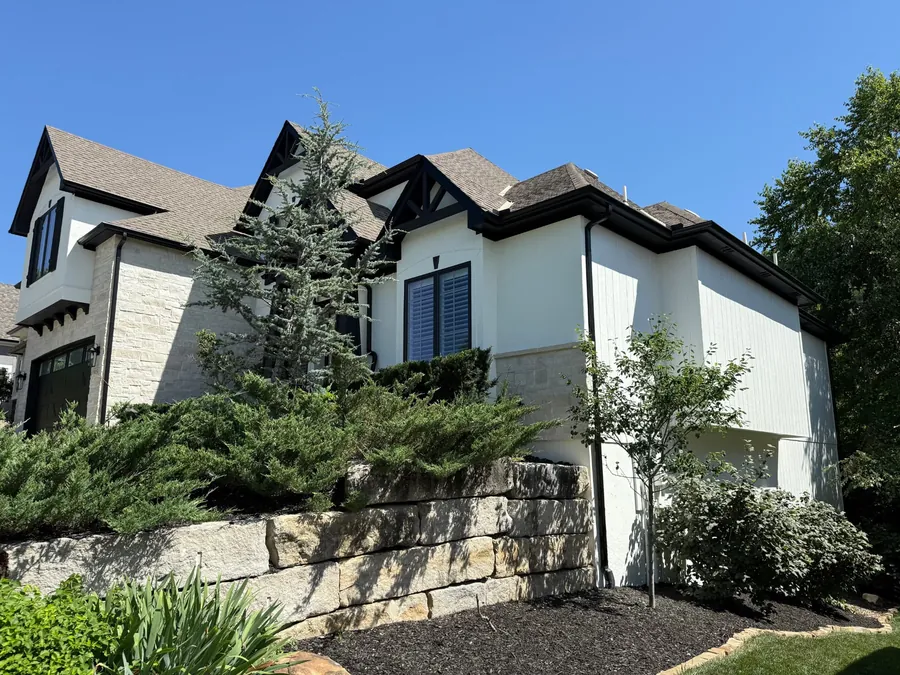
Much of Prairie Village was built in the years after World War II — ranches, Cape Cods, and story-and-a-half homes with wood trim, lap siding, and decades of paint layers. Those homes hold up well, but the same spots go first on almost every one: window sills, the bottom edge of garage door trim, fascia behind the gutters, and the trim around a back door or porch. Like the rest of the Kansas City area, freeze-thaw winters and heavy spring storms work water into any joint that's open.
An exterior repaint here starts with a walkaround for soft wood and failing caulk, then washing, scraping to a sound edge, replacing rotted boards, priming bare wood, and two finish coats. Homes built before 1978 may have lead paint under the newer coats, so older layers get tested before any sanding. If you're near Prairie Village in Mission Hills, Fairway, Mission, or Leawood, it's the same crew and the same process.
Services in Prairie Village
Each service has its own page with the full process — prep sequence, materials, timelines, and what gets checked before the job is called done.
Towns we serve
- Prairie Village
- Mission Hills
- Fairway
- Mission
- Leawood
- Overland Park
Common questions
Yes. Layered older enamel needs sanding to break the gloss and level the edges of prior coats, plus a bonding primer, or the new finish sits on top of old ridges and shows every one of them.
That's a matter of film build. Detail disappears when coats are laid on heavy. Thinner, properly leveled coats keep the profile crisp.
Yes. Plaster gets patched and skimmed rather than treated like drywall, and cracks get addressed at the source before any coating goes on.
Yes. Exterior repaints in Prairie Village usually start with the trim, fascia, and window sills, because that's where older wood takes on water. Soft spots get cut out and replaced, bare wood gets primed, and the body and trim get two finish coats.
We work in a defined area, protect floors and furniture, mask off adjoining rooms, and clean up at the end of each day so the house stays livable.
Ready to bring your color to life?
Tell me about the project and I'll come walk it with you — no pressure, no sales pitch.